
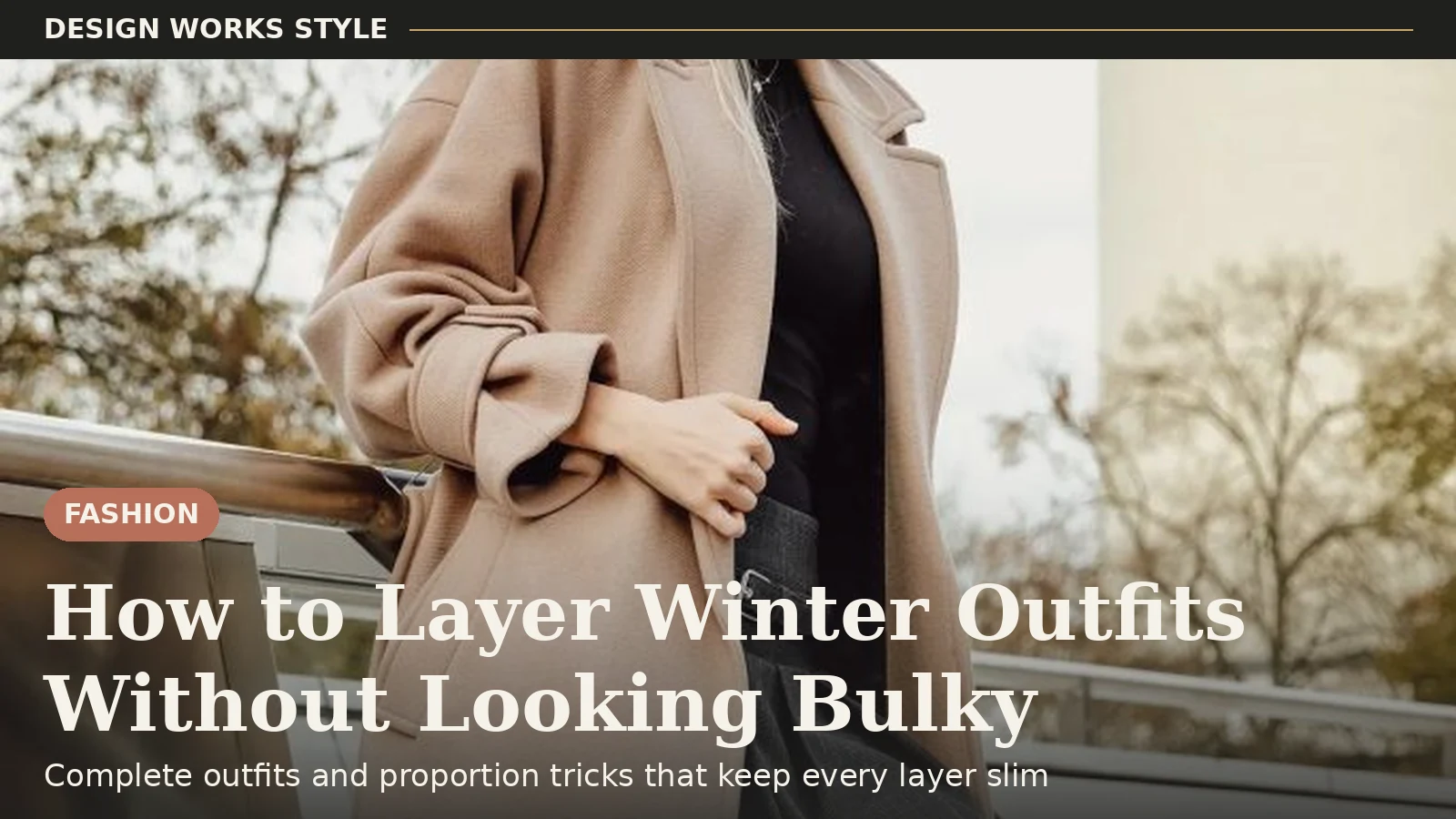
How to Layer Winter Outfits Without Looking Bulky
To layer clothes for winter without looking bulky, keep the pieces close to the body thin and put volume in only one place. Start with a fitted top, add a mid layer that ends at a different length, and finish with a coat that closes over the stack. The outfit looks neat when each layer shows a little.
How Do You Layer Clothes Without Looking Bulky?
Layer clothes by building from thin to thick and keeping each layer visible at a different point. A fitted top sits against the body, a sweater or blazer adds warmth in the middle, and the coat covers the outside. The stack stays neat when the coat closes, the sleeves move freely, and the hem of one layer peeks out below the next.
The three-layer idea behind winter fashion still holds as the base of the plan: thin inside, warm in the middle, coat on top. This article deals with what sits on top of that idea, the outfits themselves.
Two rules carry most of the work. First, only one piece in the outfit gets to be bulky: a chunky sweater pairs with slim trousers, and wide-leg trousers pair with a fitted top. Second, every layer needs its own edge, like a shirt hem below the sweater or a collar above the coat. These small visible edges tell the eye the outfit has layers on purpose.
Try the coat test before you leave the house. Put the whole outfit on, close the coat, and sit down. If the coat pulls at the buttons or the sleeves bunch at the elbow, take one layer off. The layer you remove is usually the one you added last, and the outfit rarely misses it.
What Does a Layered Work Outfit Look Like?
A layered work outfit starts with a fitted turtleneck or a white shirt, adds a blazer or a fine knit cardigan, and finishes with a knee-length wool coat. The trousers stay tailored, the boots stay low, and nothing in the stack is thicker than it needs to be.
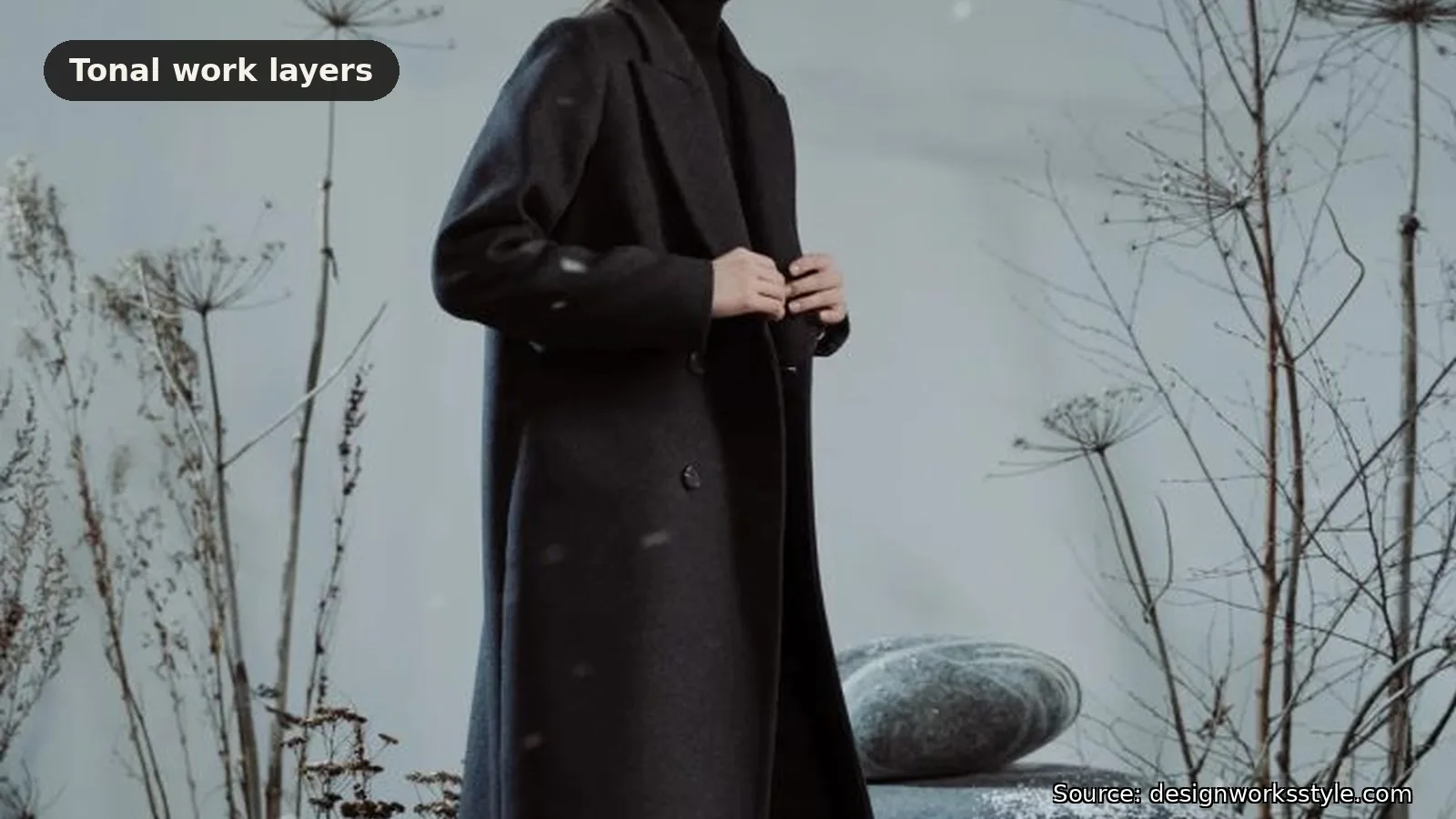
A single color from top to toe helps more than any one garment. Black, charcoal, or navy worn head to toe makes the layers read as one column, and the eye stops counting them. Break the column once, with a scarf or a belt in a second color, and the outfit still holds together.
The blazer earns its place in a work outfit because it does two jobs at once. It is the mid layer that adds warmth, and it is the piece that looks finished when the coat comes off at the office. Pick a blazer with room for a thin sweater underneath, and check that the coat closes over it.
For the bottom half, tailored trousers beat jeans for work because they hang straight under a long coat. Add thin thermal leggings underneath on the coldest days; nobody sees them, and the trousers still sit the same way.
How Do You Layer a Casual Day Outfit?
A casual day outfit layers a fitted long-sleeve top, a chunky knit or a flannel shirt, and a hip-length puffer or a parka. Straight-leg jeans and flat boots keep the bottom half simple, so the volume up top has room to breathe. The whole outfit should feel easy to move in.
Casual layering allows one oversized piece, and the choice of which piece matters. An oversized sweater works when the jeans are slim and the coat is straight. An oversized coat works when the sweater underneath is fitted. A big sweater under a big coat hides your shape completely.
Accessories count as layers on a casual day. A thick scarf adds warmth around the neck and chest, a knit hat covers the ears, and gloves finish the hands. Put the scarf on after the coat, not under it, so it sits on top of the collar and frames the face.
How Do You Layer for an Evening Out?
An evening outfit layers a dress or a silk top, a fitted knit or a blazer, and a long wool coat, with heeled boots underneath. The coat comes off at the door, so the layers underneath need to look complete on their own.
The trick for evenings is to plan the outfit in two states: walking there, and sitting at the table. The coat handles the walk. The dress or top, the knit, and the boots handle the table. If the outfit under the coat looks bare, add the blazer or a fine cardigan as the middle piece.
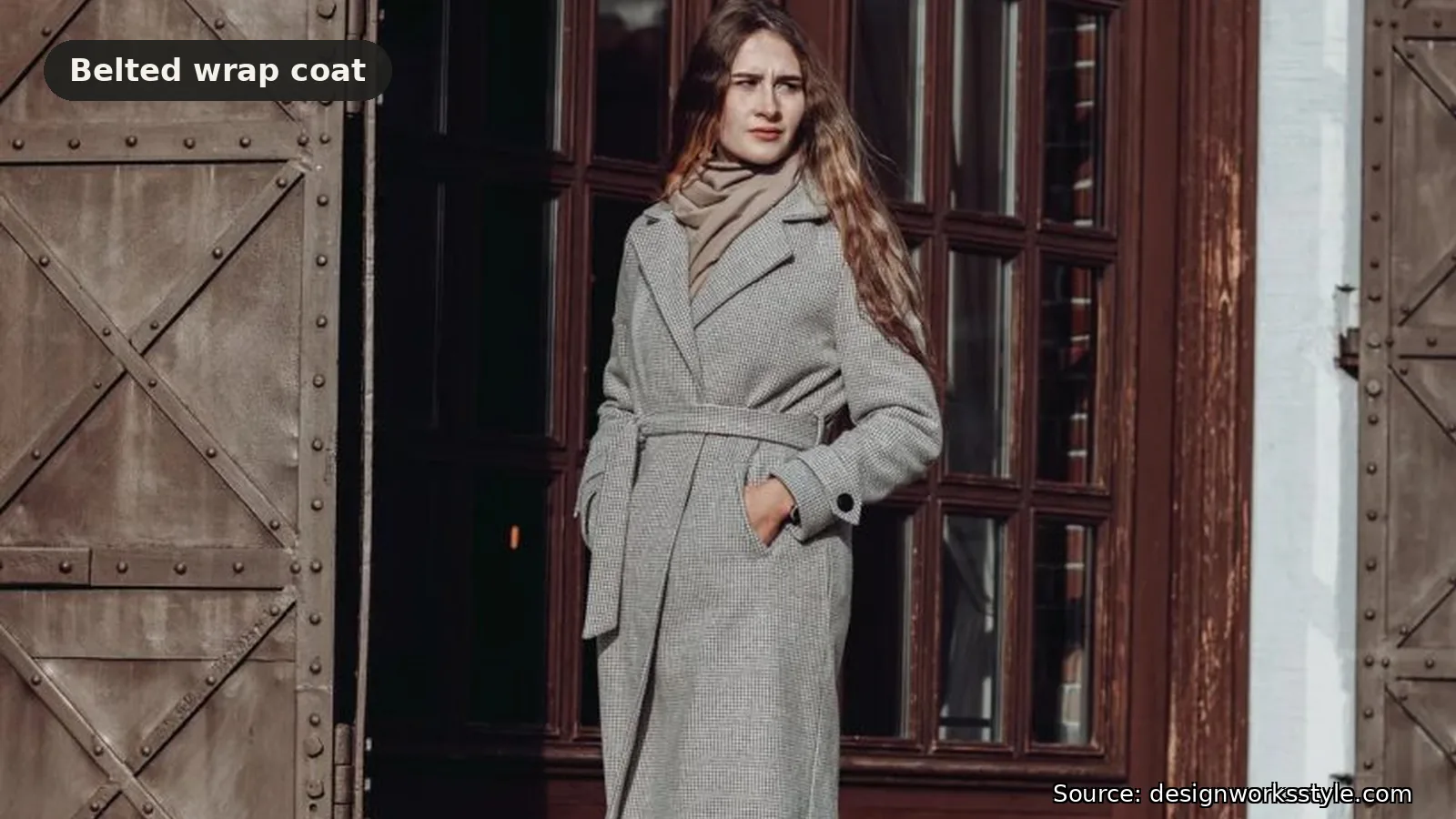
Leave the puffer at home for the evening. A long wool coat or a tailored wrap coat suits a dress, and it hangs better over a blazer. The puffer is warm, but its shape fights with the shape of a dress.
How Do You Layer Dresses and Skirts in Winter?
Layer a dress by adding warmth underneath it, not on top of it in thick pieces. Opaque tights, a thin thermal layer under the dress, and a long coat over it keep a dress wearable through winter.
Knit midi skirts are the easiest winter skirt to layer because they pair with almost any top. A fitted turtleneck tucked into the skirt, ankle boots, and a long coat make a complete outfit with only three visible pieces. A pleated midi skirt needs a shorter top layer, like a cropped sweater, so the waistline still reads.
Boots matter more with dresses than with trousers because the gap between the hem and the boot is on display. Knee-high boots close that gap and keep the leg warm, and they pair with midi lengths. Ankle boots pair with a shorter hem or with a long coat that covers the gap.
What Do You Take Off Indoors and Still Look Finished?
Take the coat, scarf, hat, and gloves off indoors, and keep everything underneath as the outfit. The layers under the coat need to look complete on their own, with a collar or a neckline that reads as finished and a top that is not wrinkled from the coat. If the outfit only works with the coat on, it is not finished.
Build the indoor outfit first, then add the coat. Start with the shirt, sweater, or dress you will wear at the desk or the table, and make sure it looks right in a mirror without the coat. Then add the coat and check that it closes over the stack.
The blazer is the piece that saves most indoor outfits. A blazer over a shirt or a fine knit looks like a complete outfit the moment the coat comes off, and it adds a layer of warmth in a cold office. A cardigan does the same job in a softer way, and it suits a casual workplace.
Where Should Volume Go and Where Should It Stay Flat?
Put volume where the body is narrowest in the outfit, and keep it flat where the body is widest. A full sleeve works with slim trousers, and a wide trouser works with a fitted top. The waist is the place to define the shape, with a belt, a tucked top, or a coat that closes at the waist.
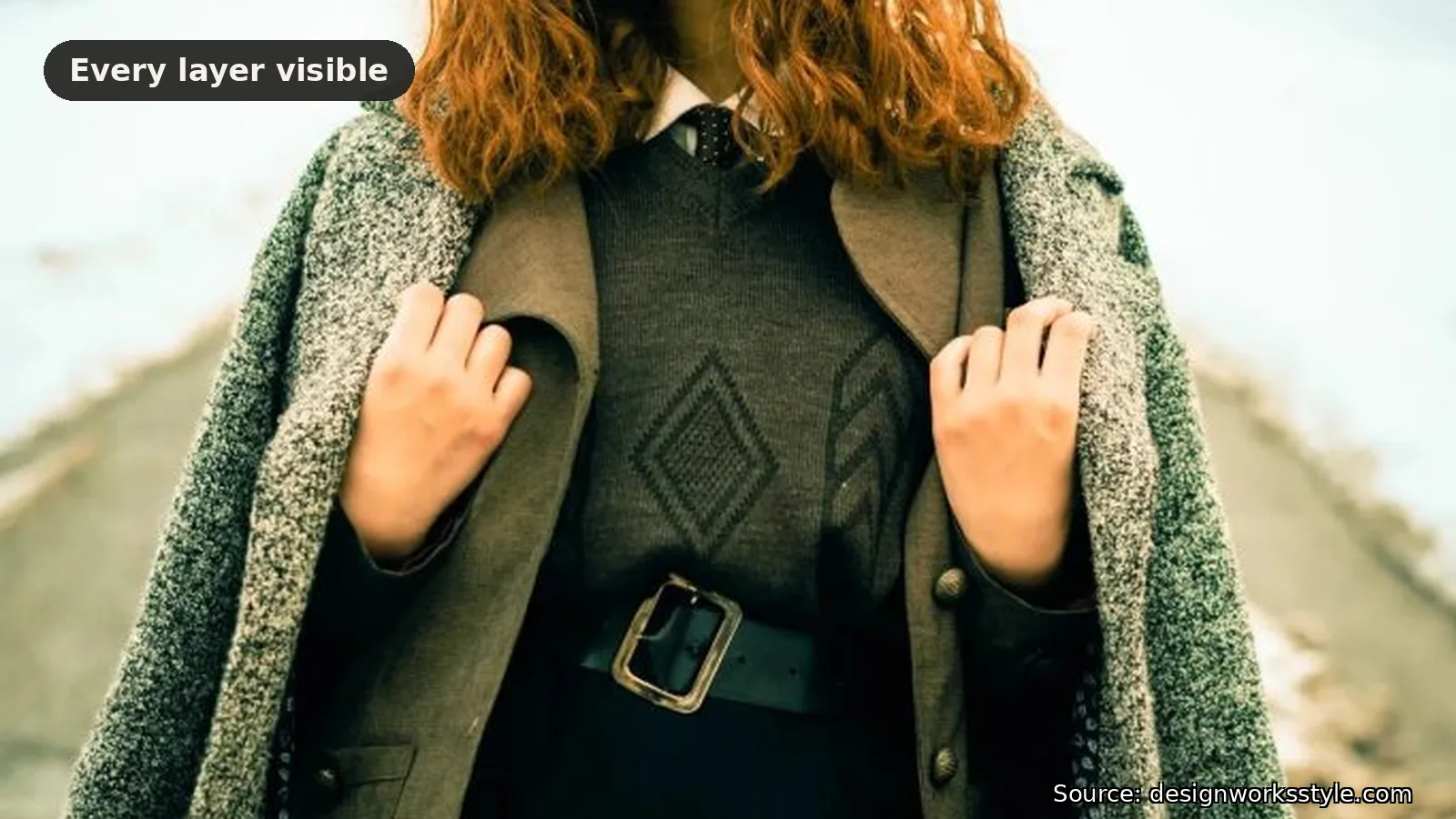
Staggered hems are the simplest proportion trick in winter dressing. Let the shirt end below the sweater, the sweater end below the jacket, and the jacket end below the coat. Four layers that all end at the hip make a thick band around the waist, and that band is what reads as bulky.
Belted coats and open coats solve different problems. A belted coat defines the waist over the layers underneath, and it suits outfits where the layers are loose. An open coat shows the outfit underneath and suits a neat stack where the waist is already defined by a tucked top.
Cropped layers and long layers play different roles. A cropped sweater over a long shirt shows the shirt hem and keeps the waist visible, which suits wide trousers. A long cardigan over a dress adds a vertical line that lengthens the body, which suits a midi length.
What Are the Common Bulky Mistakes by Silhouette?
The most common bulky mistake is stacking two thick pieces on the same part of the body: a chunky knit under a puffer, or wide trousers under a long full coat. The fix is to thin one of the two pieces. A fitted knit under the puffer keeps the warmth and drops the bulk.
Tall frames can carry a long coat and a long scarf, but a long coat over a long sweater over wide trousers stretches the outfit into one long block with no break. A belt at the waist or a shorter mid layer breaks the line. Petite frames face the opposite problem: a knee-length coat over a midi skirt hides the legs entirely, so a hip-length coat keeps the proportions visible.
Curvy frames look bulky when every layer is loose, because loose layers add width at each step. A fitted base, a defined waist, and a coat that follows the body line keep the shape. Straight frames look bulky when every layer is boxy, because boxes stack into a bigger box.
A quick check of how to dress for your body type before you start stacking layers saves a lot of trial and error, since the proportions that suit your frame decide where the volume should go.
How Do You Layer With Pieces You Already Own?
Start with what is already in the closet: a fitted top, a sweater, a blazer or cardigan, jeans or trousers, and a coat. Lay them out in a thin to thick order and try the coat test on each combination. Most closets already hold three or four workable stacks.
A winter capsule wardrobe built from 15 pieces you already own works because every piece pairs with at least three others. Check each piece against three items in the closet before you buy anything new. If a piece pairs with only one outfit, leave it out of the stack.
Shop your closet before you shop a store, and make a short list of the gaps. The usual gaps are a thin thermal top, opaque tights in black, and a belt that sits well over a coat. Those three cost less than one new coat, and they make every outfit in the closet layer better.
Frequently Asked Questions
How many layers should you wear in winter?
Three layers cover most winter days: a fitted top against the body, a warm mid layer, and a coat on top. Add a fourth layer only when the temperature drops well below freezing, and make it a thin one, like a thermal top under the shirt. Four thick layers will always look bulky.
How do you layer clothes for winter if you run hot indoors?
Build the indoor outfit first and treat the coat as the only outdoor layer. A light shirt or a fine knit with a blazer works indoors, and the coat comes off at the door. Skip the thermal base layer on days you will spend mostly inside.
Can you layer a dress in winter without tights?
Yes, with knee-high boots and a long coat, or with a midi dress over slim trousers in the coldest weather. Knee-high boots close the gap between the hem and the foot and keep the leg warm. Bare legs with ankle boots and a short dress look cold in winter, so save that pairing for mild days.
What coat works best over layers?
A knee-length wool coat with a clean shoulder works over most layered outfits because it has room in the body without adding bulk of its own. It should close over a sweater and a blazer without pulling, and the sleeves should reach the wrist with the sweater underneath.
Image sources: Photos here come from real photographers and stock photo libraries. For the full list of image sources, visit our sources page.