
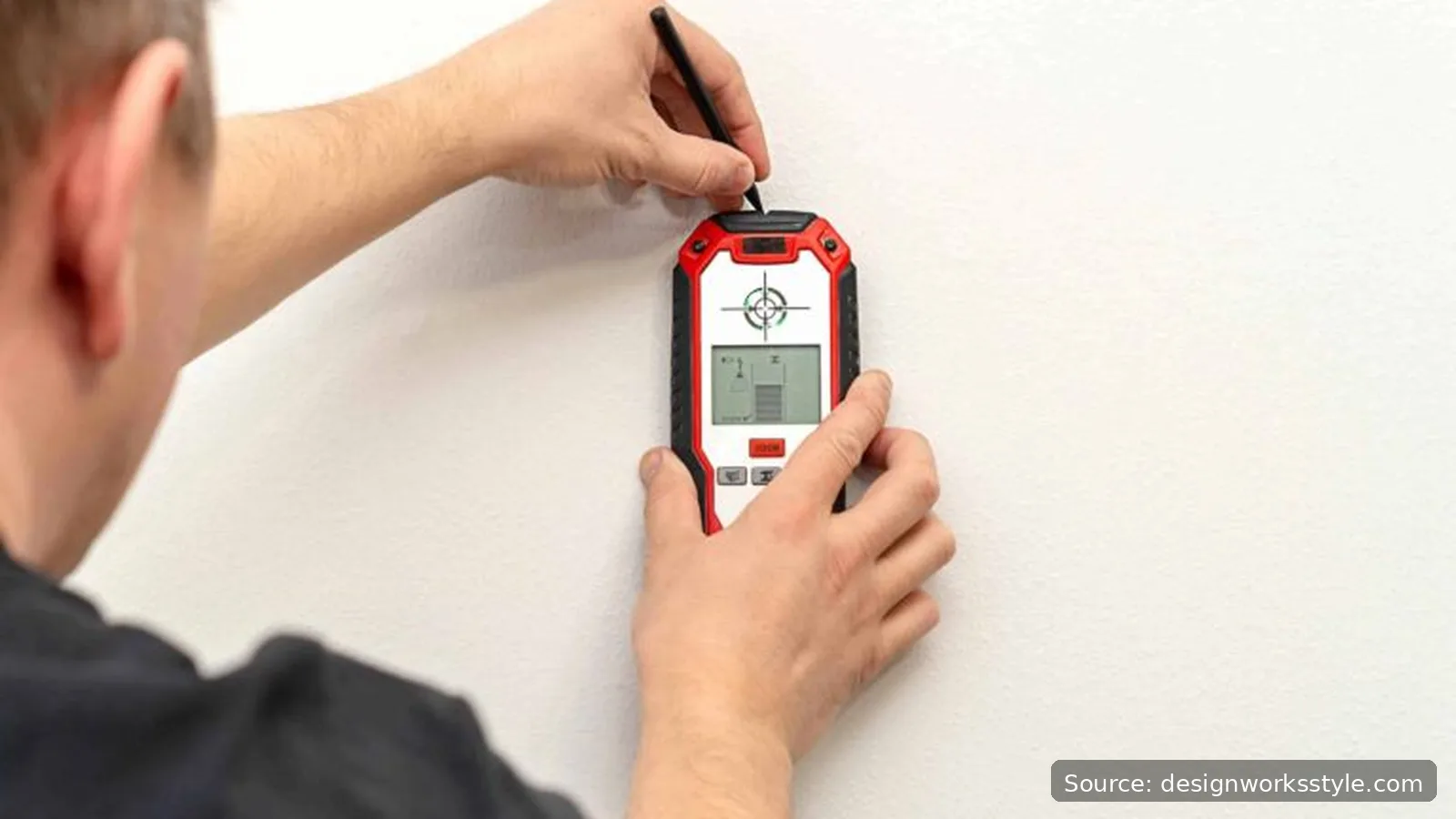
Wall studs are the vertical wood or metal framing members behind your drywall, usually spaced 16 inches apart. The fastest way to find one is an electronic stud finder: calibrate it on a stud-free section, then slide it slowly until it signals. No stud finder? Knock for the solid sound, check beside electrical outlets (they mount to studs), or use a strong magnet to find the drywall screws.
Finding a stud is the difference between a shelf that holds and a shelf that rips out of the wall. Drywall alone supports almost nothing. A screw driven into a stud holds fifty pounds or more. The same screw in bare drywall holds a picture frame, maybe, until someone slams a door. Every hanging project starts here.
What Is a Wall Stud?
A stud is a vertical 2×4 (actually 1.5 by 3.5 inches) that forms the skeleton of a framed wall, running floor to ceiling. They are the solid wood you need to hit when hanging anything heavy. The next section covers exactly how far apart they sit and how to use that spacing to find them.
How Far Apart Are Wall Studs?
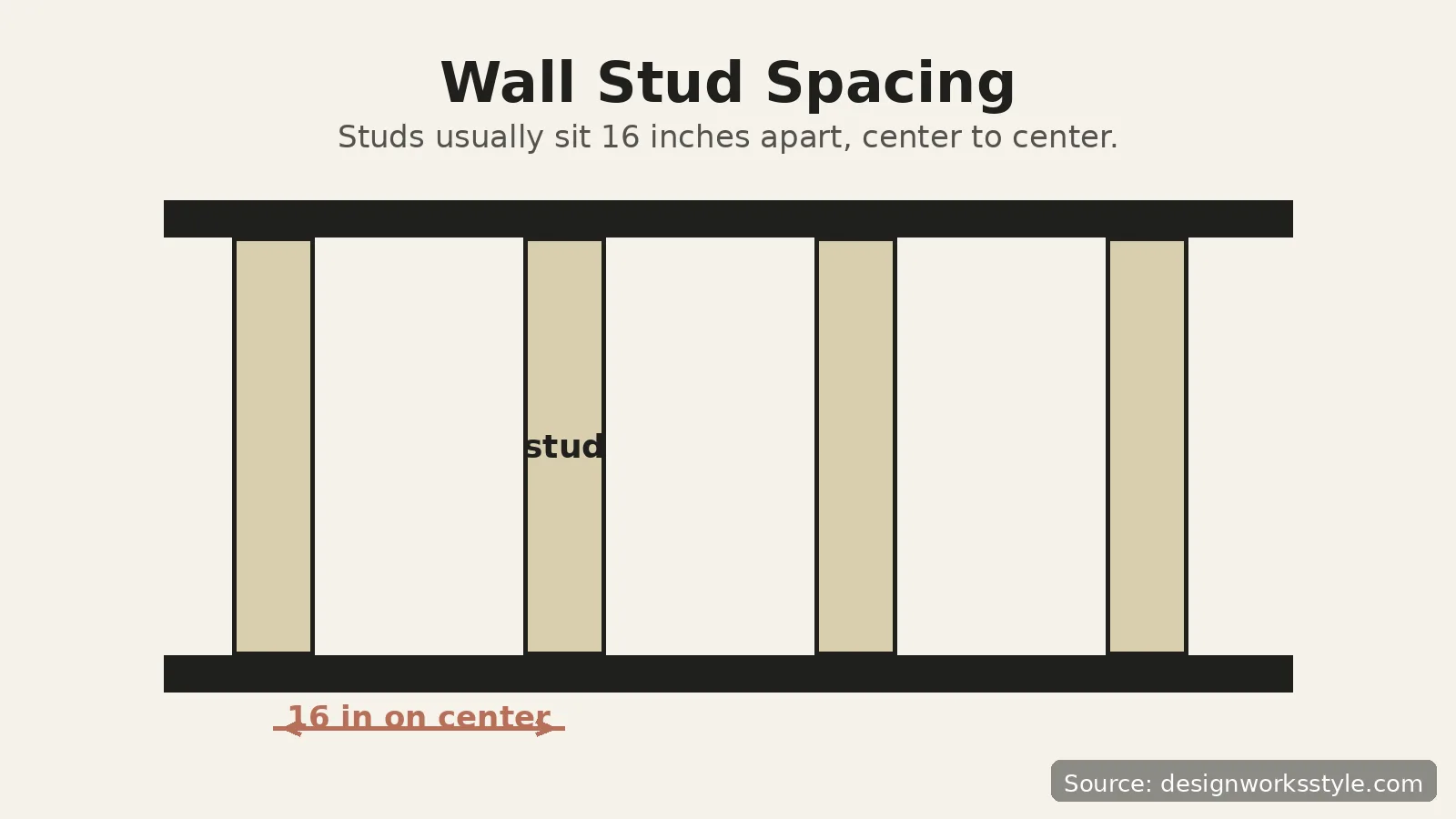
Most wall studs sit 16 inches apart, measured center to center. This is called 16 inches on center, and it is the standard for load-bearing and exterior walls. Interior non-load-bearing walls sometimes use 24 inches on center. Once you find one stud, measure 16 inches sideways to predict the next, then confirm with a knock before drilling.
The outlet trick is the fastest way to find your first stud. Electrical boxes are nailed to the side of a stud, so check which side of the box the attachment is on. That stud is your zero point. Measure 16 inches in either direction and knock to confirm. In kitchens and bathrooms, where outlets are plentiful, you can map a whole wall in minutes without any tools.
Corners give you another starting point. Wall framing typically starts at the corner, so studs often fall at 16, 32, and 48 inches from the inside corner. The corner itself usually has doubled or tripled studs for nailing drywall, which can confuse a stud finder with an extra-wide signal. If your finder reports a stud that seems too wide near a corner, that extra width is the corner assembly at work. Measure from the corner and work outward from there.
Twenty-four-inch spacing shows up in interior non-load-bearing walls, garage walls, and some newer construction built to save lumber. If you measure 16 inches from a known stud and find nothing, try 24 before assuming the wall is stud-free. Metal studs follow the same 16 or 24-inch layouts. If your tape measure has small black diamonds at 19.2-inch intervals, that marks a third spacing used with engineered floor joists. It is rare in walls, but now you know what the diamonds mean.
Older homes get a pass on all of this. Balloon-framed houses and pre-1950s construction can have irregular spacing, full-dimension 2x4s, and studs that wander off layout. Treat spacing as a starting prediction and always verify with a nail before you drill the real hole.
How Do You Use a Stud Finder?
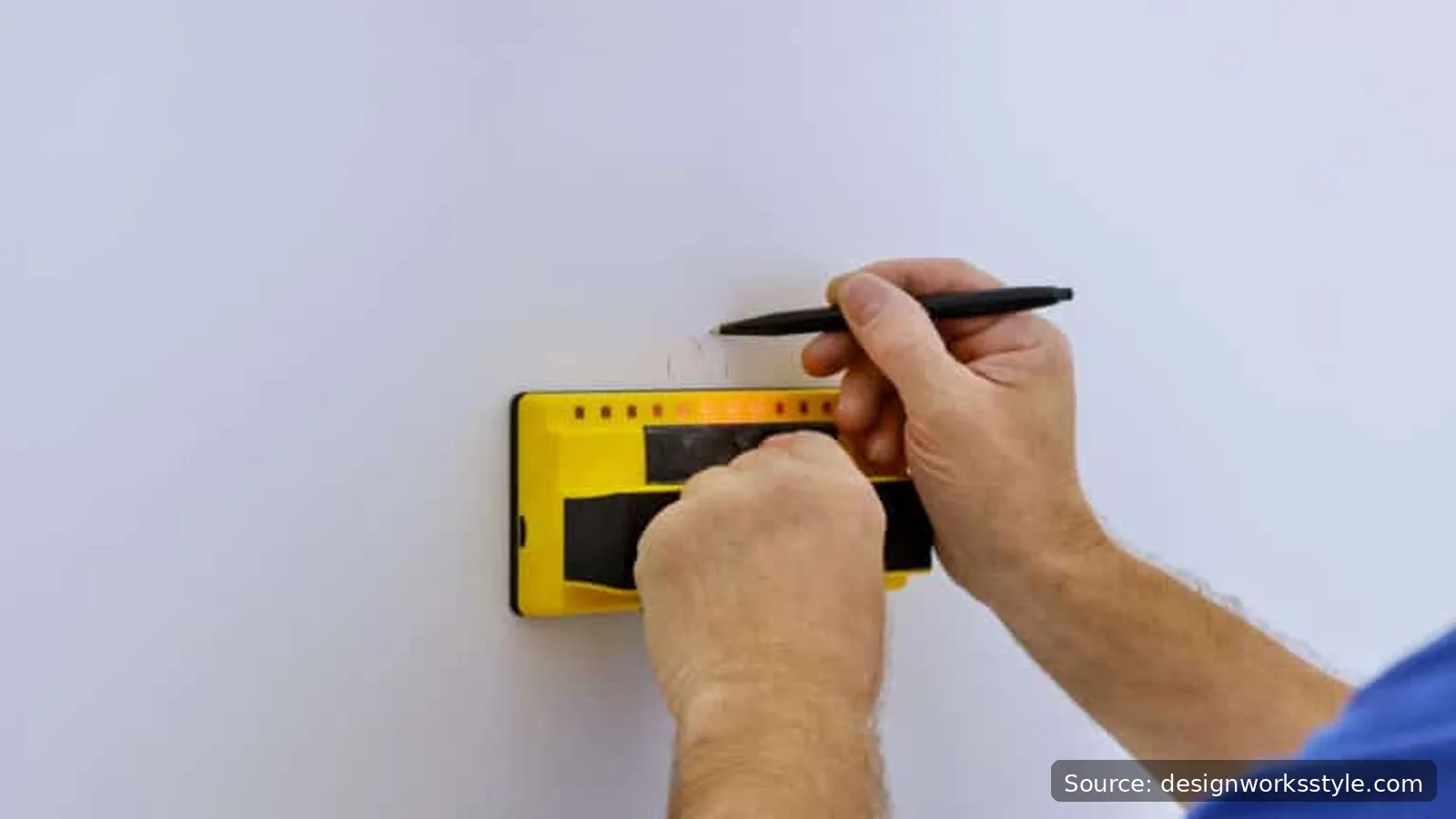
Place the stud finder flat against the wall in an area you are confident has no stud, press and hold the calibration button until it signals ready, then slide it slowly horizontally. When it beeps or lights up, you have found a stud edge. Mark it, keep sliding to find the other edge, and mark that too. The center between your marks is the sweet spot for your screw. Move slowly. Fast passes miss narrow studs, and starting calibration over a stud throws off the reading for the whole sweep.
Cheap stud finders work fine on standard drywall. Deep-scan models earn their price on plaster walls and double-layer drywall, where basic sensors get confused. Whatever model you own, verify the find before drilling: drive a thin finish nail at your mark and feel for the resistance change. A nail that sinks with steady pressure hit wood. One that punches through easily did not.
Learn the difference between edge finding and center finding. Basic stud finders detect the edges of a stud: mark one edge, sweep from the other direction to mark the second edge, and the middle is your target. Higher-end models have a center-find mode that locates the middle directly. Either way, scan from both directions. Studs are only an inch and a half wide, and a single-direction sweep can place your mark far enough off-center to miss the wood.
Use deep-scan mode on thick walls. Standard scanning reads about half an inch to three-quarters of an inch deep, which covers single-layer drywall. Plaster, double drywall, and tile backer need the deep setting, usually a separate button or mode. Deep scan is slower and more prone to false positives, so narrow the search area first with the outlet or knock method, then deep-scan only that section.
Many stud finders also detect live AC wiring. If yours does, pay attention to the warning and shift your drilling point a few inches away from any wire signal. Wires typically run horizontally through holes in the studs, about 12 to 16 inches above outlets, and vertically up from outlets and switches. Finding a stud and a wire in the same spot is common. The stud is still usable; just drill where the wire is not.
How Do You Find Studs Without a Stud Finder?
Start with the knock test: rap the wall with your knuckle as you move sideways. Hollow drywall sounds empty and resonant; a stud sounds solid and dull. It takes practice but it works. Next, look at your electrical outlets and light switches. The boxes mount directly to studs, so there is a stud immediately to one side of every outlet. Measure 16 inches from there and knock to confirm.
The magnet trick is the most reliable no-tool method. Drywall screws and nails contain steel, and a strong neodymium magnet dragged slowly across the wall will catch on every fastener. Fasteners run in vertical lines along studs, so two catches in a vertical line means you found one. Check the baseboards too: the finish nails holding them are driven into studs, and a magnet finds them easily along that horizontal line.
How Do You Find Studs in Plaster Walls?
Plaster walls are harder because the wood lath behind the plaster creates density everywhere, which fools basic stud finders into false positives. Use a deep-scan stud finder, or go straight to the magnet method: plaster was nailed to the studs through the lath, and those nails are findable. The knock test is less useful on plaster since the whole wall sounds relatively solid. When you do drill, expect more resistance and use a masonry-style slow speed to avoid cracking the plaster around the hole.
Do All Walls Have Studs?
No. Masonry walls (brick, block, poured concrete) have no studs at all. Neither do some apartment partition walls, which may be metal channel or even just double drywall. If the magnet finds nothing, the knock test sounds uniformly solid, and 16-inch measuring turns up nothing, you may be dealing with masonry. Those walls need masonry anchors and a hammer drill, not wood screws. Metal studs do exist in commercial buildings and some newer homes: a magnet finds their screws, but the studs themselves are thin steel that needs self-tapping screws or toggle bolts rather than wood screws.
Once you can find studs reliably, the hanging projects get easy. Our guides to hanging pictures and hanging curtains both assume you can hit solid wood when it counts.
What Do You Do When You Can’t Find a Stud?
Use a drywall anchor rated above the weight you are hanging. Toggle bolts hold the most, around 50 to 100 pounds each in half-inch drywall. Molly bolts hold 25 to 50 pounds. Self-drilling threaded anchors hold 25 to 50. Simple plastic expansion anchors hold 10 to 25 pounds. Match the rating to the load and anchors are fully legitimate hardware.
Toggle bolts are the strongest because of how they work. The bolt passes through a hole in the drywall, and spring-loaded wings open flat against the back of the panel, spreading the load across a wide area. They need a larger hole, about half an inch, and they cannot be removed without the wings falling inside the wall, so they suit things you plan to leave up. For curtain rods, heavy mirrors, and large frames, toggles are the default choice when no stud is available.
Molly bolts and self-drilling anchors cover the middle range. A molly bolt’s metal sleeve expands behind the drywall as you tighten the screw, gripping firmly, and it stays in the wall if you remove the screw, which makes it reusable. Self-drilling threaded anchors screw directly into the drywall with a Phillips head, no pilot hole needed, and they are the fastest option for medium loads like towel bars and small shelves. Plastic expansion anchors are fine for light duty: thermostats, small hooks, and lightweight frames under 10 pounds.
Some things must go into a stud no matter what. TV wall mounts, grab bars, heavy floating shelves, garage storage racks, and anything over about 50 pounds belong in solid wood. So does anything a child might climb or pull on. Anchors hold static weight well, but they are weaker against the prying, dynamic loads that come from a toddler swinging on a shelf or a TV mount extending outward. When the consequence of failure is injury or a shattered screen, find the stud.
Two more rules make anchors reliable. First, ratings assume half-inch drywall in good condition. Thinner drywall, water-damaged drywall, or crumbling old plaster all hold less, so downgrade your expectations accordingly. Second, use two anchors and split the load whenever you can. Two 25-pound anchors share the load, which is far stronger than either alone and gives you a margin if one loosens over time.
Frequently Asked Questions
Can you use your phone as a stud finder?
Stud finder apps use your phone’s magnetometer to detect the metal fasteners in the wall, similar to the magnet trick. They work, but weakly: phone sensors are far less sensitive than a dedicated magnet, so results are inconsistent. A three-dollar neodymium magnet outperforms every free app. A fifteen-dollar stud finder outperforms both.
How far apart are wall studs?
Sixteen inches on center is the standard for load-bearing walls and most exterior walls. Interior non-load-bearing walls sometimes use 24-inch spacing. Older homes can be irregular, so treat spacing as a starting guess and verify with a knock or a nail rather than trusting it blindly.
Why does my stud finder beep everywhere?
Usually it was calibrated over a stud, which makes everything read as dense. Recalibrate on a section you know is empty. On plaster walls, the lath confuses basic sensors; switch to deep-scan mode or use the magnet method instead. Electrical wiring and metal pipes can also trigger false positives, which is why you verify with a nail before drilling.
What if there is no stud where I need to hang something?
Use a drywall anchor rated for the weight. Toggle bolts hold the most (up to 100 pounds in half-inch drywall), followed by molly bolts, with simple plastic expansion anchors fine for light items under 20 pounds. Anchors are a legitimate solution, not a hack. Just match the anchor rating to the actual weight and you will be fine.